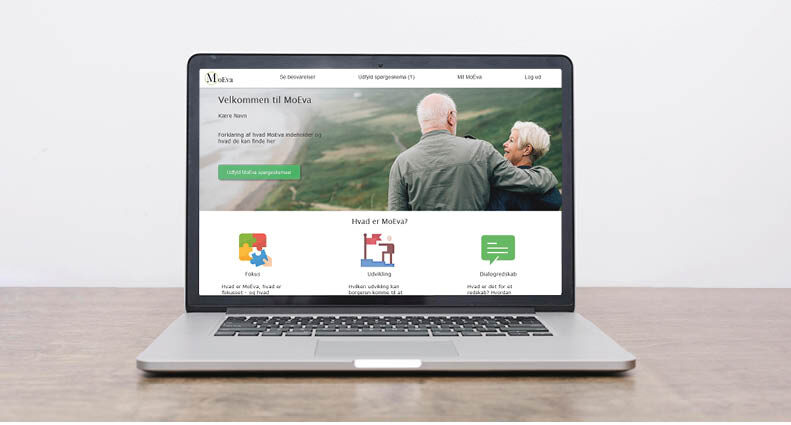
At Region Midt, I was brought on as a UX designer to improve the MoEva tool, which healthcare professionals use to monitor chronically ill citizens. The aim was to strengthen the dialogue between citizens and professionals, going beyond the existing survey data.
My role involved conducting user research and creating the initial draft of MoEva 2.0, setting the stage for further development. With a two-month timeline, I developed a project plan to ensure on-time delivery.
Process
I started with stakeholder mapping and an as-is analysis of the current system. The user research involved 10 semi-structured interviews and a workshop with five citizens. The research was conducted in two phases: the first examined the understanding and use of current surveys, while the second focused on enhancing dialogue between citizens and professionals.
Requirements to the design
The tool needed to visualize survey responses in a way that motivates citizens and facilitates dialogue. I iterated the interviews to refine these insights, leading to a workshop where various visualizations were tested with citizens to understand their preferences.
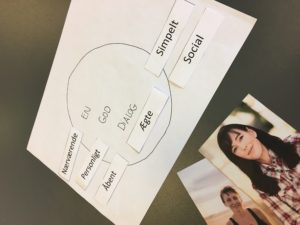
You can see a picture of the interview artifacts used here:
Workshop
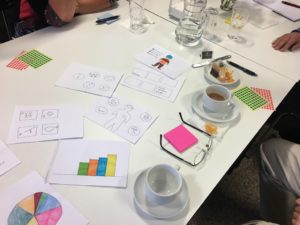
At last we held a workshop, where I drew different kinds of visualizations to get the citizens point of view on what would make sense for them and why – you can see a picture of it here:
I used empathy mapping to capture the sensitive nature of the interactions and created low-fidelity wireframes based on my findings. The final designs were handed over for further development.
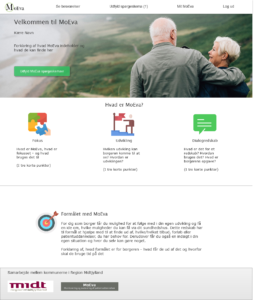
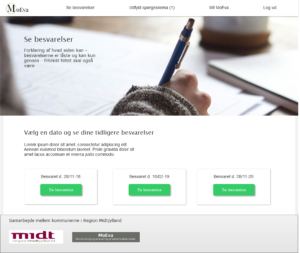
Here is a few pictures of the low-fidelity wireframes made for the citizens:
Conference ‘Borgerinddragelse i forskning 2.0’ at Syddansk University (SDU)
The findings from this project were presented at the “Borgerinddragelse i forskning 2.0” conference at Syddansk University, with plans for MoEva 2.0 to be implemented across several municipalities.
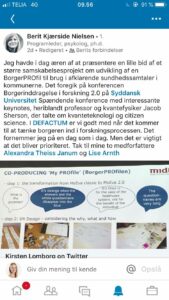
You can see a picture of it a following LinkedIn post right here.